The team’s history began in 1992. No further words are needed to describe Jorge Martínez, who forged his legend in the late eighties, sealing four world titles and an impressive trophy cabinet that would make him one of the greatest exponents of international motorcycle racing to this day. As tenacious as few others, he knew his days as a rider would eventually come to an end, which is why he decided to found the Aspar Team in 1992, to continue savouring glory and enjoy the epilogue of his professional career as the head of his own team. Several podiums and his last victory (Argentina, 1994), achieved within his own structure, feature in the team’s record.
In 1997 he hung up his leathers, but continued travelling from circuit to circuit, leading the team. Although as a rider he only had to worry about winning, as a team manager his concerns multiplied. In the late nineties the team cemented its essence with several national and European titles, but it was the dawn of the new century, in the 2000s, when the explosion came: world champions, runners-up, victories, one-two-threes… successes followed one after another, combining discipline and passion to turn the team into today’s worldwide benchmark. Without doubt, to highlight the first major milestone of the Valencian outfit, one must go back to 2002, when alongside Fonsi Nieto the team achieved its first 250cc world runner-up title. 2004 was another breathtaking season, with a new runner-up finish in the intermediate class, this time with Sebastián Porto.
Two specific flashes that signalled the rising wave that was about to begin: the first 125cc title with Álvaro Bautista. Before celebrating, that year 2006 had several historic highlights and an unprecedented feat in the World Championship: three riders from the same team occupied the entire podium at Istanbul Park in Turkey. Victories, podiums and pole positions followed one after another, and in Australia Álvaro Bautista rode triumphantly after securing the first title for the Aspar Team. The rider from La Mancha accumulated 338 points on his way to the 125cc crown, the highest score in recent times in the smallest class. Four of the five riders of the Valencian outfit finished in the top five in the overall end-of-year standings. Without doubt, an overwhelming dominance.
When everything suggested it would be impossible to set the pace so clearly again, the team did it once more in 2007. Only a few races were needed to confirm that the 125cc title would also rest in the Aspar Team’s trophy cabinet at the end of the season. Héctor Faubel and Gábor Talmácsi dominated the smallest class with an iron grip, extending their duel to the final round in Valencia, where the Hungarian took the title and the Valencian finished runner-up. The team continued to write its history.
2008 brought a new 250cc world runner-up finish alongside Álvaro Bautista, and in 2009 the monopoly in the 125cc class was repeated, this time through Julián Simón and Bradley Smith. The Spaniard and the Briton fought tooth and nail for a title for the history books, preventing any rival from interfering in the battle and making it clear that the team was a step above its adversaries. Julián Simón was the most consistent and finally clinched the title in the magical setting of Phillip Island. Simón was champion and Smith runner-up in 125cc, leaving behind, alongside an equally inspired Sergio Gadea, eight podium one-twos and another historic one-two-three in Assen.
2010 was a year of changes: the signing of the most promising Valencian talent of the moment, Nico Terol; the beginning of a new era called Moto2; and without doubt, the long-awaited entry into MotoGP was the big news that kept the team at the centre of all attention. Terol and Simón were 125cc and Moto2 world runners-up respectively, the former keeping the title fight alive with Marc Márquez until the final round, and the latter showing great adaptation to the new era. Valencian rider Héctor Barberá launched the team’s new source of pride: its participation in the premier class of the World Championship.
But if there was one thing that drove Jorge Martínez throughout his career, it was nurturing young talent, which is why he was a pioneer and driving force behind the riders’ school at the Circuit de la Comunitat Valenciana. A breeding ground for young riders from which all the great stars of recent times have emerged, including the last 125cc world champion, Nico Terol, who took the title with the Aspar Team in 2011. The Valencian outfit watched as a gem born from its own roots monopolised the season from start to finish under its guidance, going on to be crowned champion in front of his home crowd, at the Circuit de la Comunitat Valenciana, within a purely Valencian team. In honour of the greatest Valencian rider in history and one of the best in the world, the last 125cc world champion, himself Valencian, left his mark within the Aspar Team.
Undisputed leader in the smaller classes, MotoGP was the next stop. It was not enough to merely feature — the same winning spirit had to be stamped. In 2012, with the introduction of the new CRT category, the Valencian outfit swept all before them thanks to Aleix Espargaró and Randy De Puniet. 2013 was once again a triumphant ride for Espargaró, and a new title once again proved right a team built to win. During those years, Nico Terol, Jordi Torres and Jonas Folger continued adding victories to the team’s tally in the Moto2 and Moto3 classes, but a renewal of the project was needed in order to keep growing and face the future with the greatest possible guarantees. In 2014, the team began a new chapter in MotoGP with Honda. The Aspar Team returned to its roots, to the bike with which it made its World Championship debut in 1992, though this time in the premier class and alongside two world champions of the calibre of Nicky Hayden and Hiroshi Aoyama.
In the smallest class, the team took on a new challenge and became the spearhead of the Indian Mahindra project, a new constructor seeking to compete on equal terms against the giants of Honda and KTM. After trying alone without success, Mahindra joined forces with the Aspar Team to benefit from the technical knowledge of its human team and continue climbing the ranks. And climb they did: in their first year together came the first podium, courtesy of the Italian talent Pecco Bagnaia. But the best was yet to come, and 2016 saw its breakthrough: two victories and six podiums that brought the team back into the fight for the top positions in the smallest class.
In an effort to once again contend for the title of best independent team in MotoGP, the squad led by Jorge Martínez “Aspar” rejoined Ducati to continue climbing the ranks among the best, with Álvaro Bautista and Karel Abraham on board. In Moto3, with Andrea Migno and Albert Arenas on the new KTM, the Ángel Nieto Team — renamed in tribute to the 12+1-time world champion Ángel Nieto — returned to glory, earning two victories in France and Australia, followed by another win in Thailand in 2019.
In 2020, the pandemic could not stop the World Championship and the Aspar Team competed again in Moto3 and Moto2. Despite the health situation, 15 Grands Prix were held in which the team was able to shine, especially in the smallest class, where Albert Arenas and the Aspar Team were crowned World Champions. Aron Canet, who made his debut with the team in Moto2, was named best Rookie of the Year. That new success was added to the one achieved by Izan Guevara in the Junior Moto3 World Championship that same season.
Izan Guevara himself stepped up to the Moto3 World Championship in 2021 alongside Sergio García in the GASGAS Aspar Team. The rider from Burriana fought for the title until a crash ruled him out of 2 Grands Prix, despite which he was still able to finish third overall. Guevara finished eighth, having opened his victories account in Austin, as the second-best rookie of the year. In Moto2, Albert Arenas and Aron Canet flew the flag for the Aspar Team, which in 2022 also became GASGAS’s factory team in the intermediate class. Canet brought the team back to the Moto2 podium for the first time since 2013 and finished sixth overall.
The successes of 2021 promised a great 2022, but reality exceeded all expectations. Izan Guevara, Sergio García and the GASGAS Aspar Team set the pace in a season in which they achieved a total of 10 victories and 22 podiums. The question was not whether the team would win the World Championship, but which of its two riders would do so. Two one-twos, at Jerez and Mugello, foreshadowed that fraternal battle which ended with Izan Guevara as world champion — the sixth for the Aspar Team in the smallest class in just sixteen years — and Sergio García as runner-up, in one of the most successful seasons in the team’s World Championship history. Joy continued in Moto2 with the first podiums for Briton Jake Dixon on his return to the team two seasons later.
Unlike 2022, expectations in 2023 were lowered in Moto3 just as they rose in Moto2, where Jake Dixon climbed to the top of the podium for the first time in a superb race at one of his talisman circuits, the ‘cathedral’ of Assen. But in the smallest class it seemed impossible to soon repeat what had been achieved the previous season: the team renewed its line-up in the smallest class and brought in Japanese rider Ryusei Yamanaka and Colombian David Alonso, another new talent developed by the Aspar Junior Team who arrived at the World Championship as Spanish champion, European Talent Cup champion and Red Bull Rookies Cup champion, always under the team’s guidance. With that track record, it came as no surprise when the Colombian took his first podium at the Spanish Grand Prix, with a second-place finish just days after turning 17. But, as always, the best was yet to come — though not even the best scriptwriter could have devised a story like the one young Alonso experienced in the hours before his first World Championship victory. On Saturday, after a disastrous qualifying session, Alonso had to settle for last position on the grid. Nobody behind him, almost thirty riders ahead to overcome before leaving Silverstone with a smile. Within three laps he was third, and by the end of the race he had become the first Colombian rider to hear his country’s anthem at a world speed championship. It was not long before he tasted the podium again and three races later he had already claimed three victories. In a year that was initially meant to be one of learning, the Aspar Team once again finished on the final podium, with David Alonso third in Moto3 and with all eyes on him for 2024.
And he did not disappoint. Fourteen victories in twenty races, equalling and surpassing a record that was 27 years old — Valentino Rossi’s eleven victories in a single 125cc season. It cannot be said that David Alonso surprised anyone with his early victories, but a point was reached where the question became whether anyone was capable of stopping him. The final part of the year was breathtaking: victories at Misano, in Indonesia, in Japan (to seal the title with four races to spare!), in Australia, in Thailand, in Malaysia and in Barcelona. A feat within reach of only a select few, which allowed the team to repeat the achievement of 2022: riders’, teams’ and constructors’ champion, this time alongside CFMOTO. The alliance with the Chinese manufacturer had got off to the best possible start: with a victory in the first race and a title to round off an incredible year.
In 2025 the alliance continued with new faces: reigning Moto3 champion David Alonso stepped up a category alongside Dani Holgado, the runner-up in the smallest class the previous season. In Moto3, the CFMOTO Aspar Team fielded Dennis Foggia and Máximo Quiles as its riders. With a line-up full of rookies, the Italian excepted, nobody could have predicted what was about to unfold. In Moto3, Máximo Quiles was a revelation. Despite his delayed debut due to not yet meeting the minimum age requirement, the Spanish rider made an immediate impression in his first race in Austin, starting from the front row of the grid and crossing the finish line in a highly impressive fifth place. The podium came just two races later, at Silverstone, where he finished second, and after repeating the result at the following round, his third consecutive podium became his first World Championship victory. Throughout the season, Quiles established himself as one of the most competitive riders in the class, achieving up to nine podiums including three victories, which allowed him to fight for the top positions and end the year third in the overall standings and with the “Rookie of the Year” title to his name.
Meanwhile in Moto2, the team faced a year full of adaptation challenges with two rookie riders. However, what seemed to be a year focused on team building and adaptation to the new class became a season full of highlights for both riders. Alonso once again demonstrated his enormous talent and ability to learn, delivering a steady progression race after race and standing out for his speed and maturity despite the step up to a more demanding machine. Dani Holgado, for his part, brought solidity and consistency, scoring points reliably and progressively closing in on the leading positions. Both riders were able to secure their first trophies in Moto2 — Alonso stepped onto the podium for the first time in Great Britain and Holgado did so in Austria — as well as their first victories, in Hungary and Catalonia respectively. The young CFMOTO Aspar Team riders were the two main contenders for the best rookie of 2025 award and together amassed ten podiums, including three victories. Although the “Rookie of the Year” title ultimately went to Holgado, both riders have laid solid foundations for the future of the project in the intermediate class, making it clear that the CFMOTO Aspar Team remains a benchmark in the development and promotion of young talent.
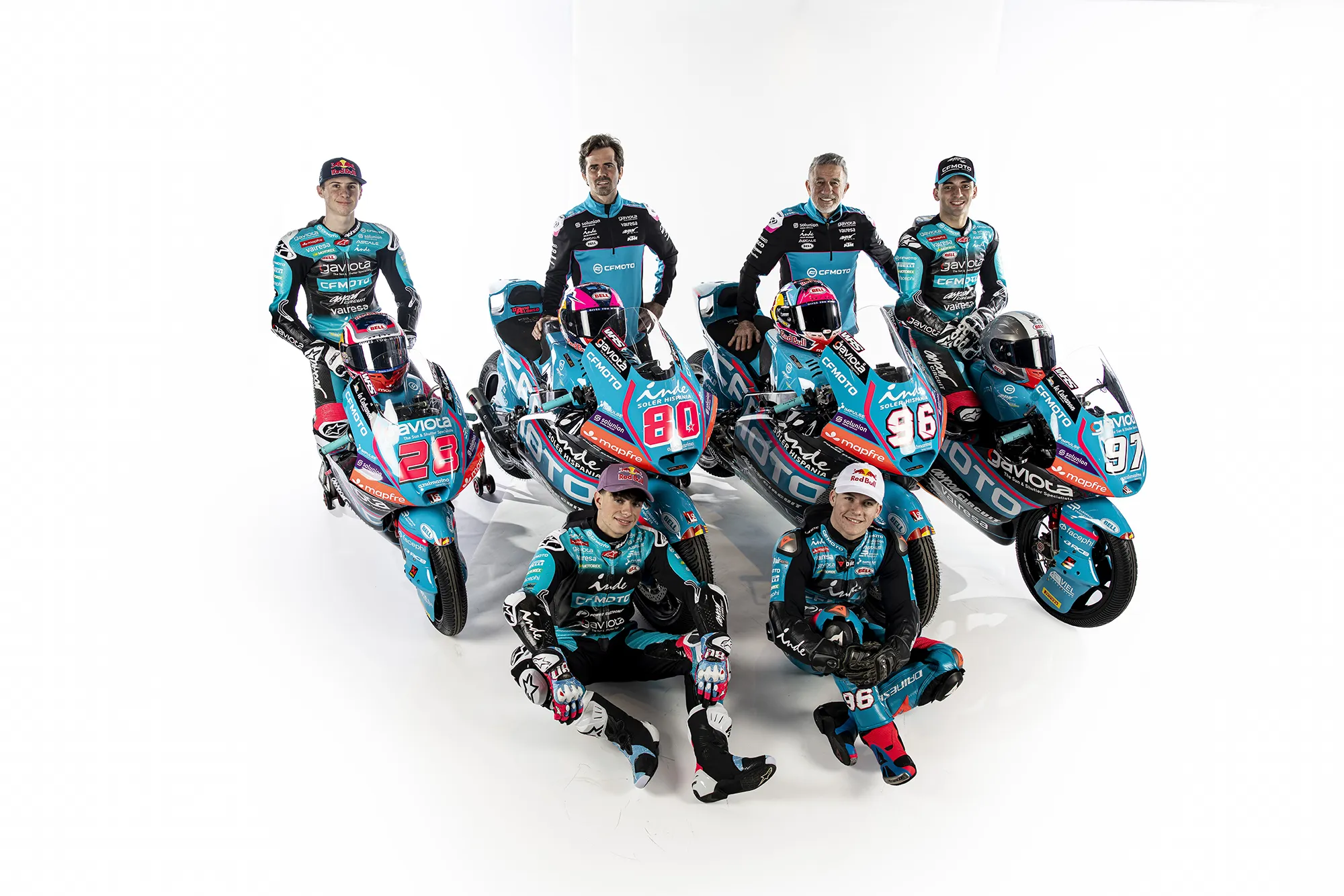
With eyes fixed on 2026, the Aspar Team faces a new season with ambition intact and a strong line-up, comprising David Alonso and Dani Holgado in Moto2, and Máximo Quiles and Marco Morelli in Moto3, with the firm objective of continuing to write pages of success in the World Championship.